
Mansfield Previous Residents by Era
Records for previous residents of a Mansfield address have uneven time coverage. The current appraisal card gives the starting parcel identity. The deed trail then moves through the county clerk's index. Historical directories and census schedules can add an address or household clue, while museum and archive material can fill a local gap. Treat the year shown by each source as part of the result, because an address or county boundary may not have had its modern form in an earlier period.
| Source | Years it covers | Where held | What it shows |
|---|---|---|---|
| TAD parcel card | Current card; sample values display 2020-2025 | Applicable appraisal district | Owner, previous owner, deed date, instrument, mailing and situs fields |
| Tarrant deed grantor/grantee index | 1876-1920 documented archive run | Tarrant archives and related holdings | Historic transfer lead; web start date was not stated |
| Tarrant tax rolls | 1876-1910 documented archive material | Tarrant archives | Taxable property and owner clue, not a household list |
| Mansfield newspaper titles | Hawkeye 1894-1896; Banner end date not located | UNT title records and local follow-up | Notices, deaths, weddings, and community names |
| Greater Dallas White Pages | 1981, 1983, 1984/85, and 1995 | UNT Portal to Texas History | Regional name, address, and telephone clues |
| Federal census | Released schedules under the 72-year rule | NARA and library databases | Household snapshot within historical geography |
A current Mansfield parcel card is normally the first stop. When the question reaches the archive era, move to the documented deed or tax material rather than assigning an unverified web cutoff to the portal.
Start Mansfield Previous Residents at the Parcel
Use the Tarrant Appraisal District for a Tarrant County address. Capture the account, TAXPIN or georeference, situs, legal description, subdivision, block and lot, owner, primary mailing address, deed date, and instrument number. The card can list prior owners and values by tax year. Its situs is the parcel location; its mailing field is where tax notices go. Neither field alone establishes the full set of people who were present at the address.
For a Mansfield parcel in Johnson or Ellis County, route the address to the proper district before concluding that no card exists. The three-county footprint is central to past-resident work. A recorded transfer belongs with the county that had jurisdiction, which can differ from an assumption based only on a current city label.
Note: Save the legal description even when the street line looks clear, because it is the more stable match in older deeds.
Tarrant Deeds for Mansfield Previous Residents
The Tarrant Official Public Records search supplies the index route for a Tarrant address. Search the current owner as grantee near the deed date from the appraisal card. Check the legal description, subdivision, block, lot, or parcel reference before accepting a result. A shared name and city is not enough. The index offers department, search term, date range, recorded-date, and index-only or index-and-full-text/OCR controls.
- Freeze the current parcel identity from the appraisal card and note its county.
- Search the current owner as grantee near the recorded deed date, using exact and variant name forms where needed.
- Read the matching result or image for grantor, grantee, document type, recorded date, instrument number, and legal description.
- Take the seller or grantor from that purchase and search the person as grantee in an earlier period.
- Repeat only where the legal description or parcel reference continues to match. Check deeds, trustee deeds, deeds of trust, plats, releases, liens, powers of attorney, and judgments when the chain calls for them.
- Move to the counter, kiosk, or archive when the online index does not reach the needed era.
- Grantor
- The party transferring an interest in a recorded instrument.
- Grantee
- The party receiving that interest, and the search role used to move backward to an earlier purchase.
- Chain of title
- The linked sequence of recorded transfers for the same parcel.
- Legal description
- The subdivision, block, lot, or other recorded land description that can identify a parcel when an address changes.
Mansfield Past Residents Beyond the Web Index
The online OPR is convenient, but the official research did not state its start or cutoff year. The documented Tarrant archive material is a separate path: the Grantee/Grantor Index to Deed Records covers 1876-1920, tax rolls cover 1876-1910, and a marriage index covers 1876-1902. Those sources are historical leads rather than proof that every image or book is available online.
The County Clerk provides online, counter, kiosk, and mail copy channels. Unofficial online downloads require an account and are watermarked. Certified copies are available online, while mail requests need a self-addressed envelope, document number, and the stated payment form. The public counter and kiosks remain useful when a historical document is outside the web workflow.
Open the Official Public Records search to see its department, term, date, and index controls.
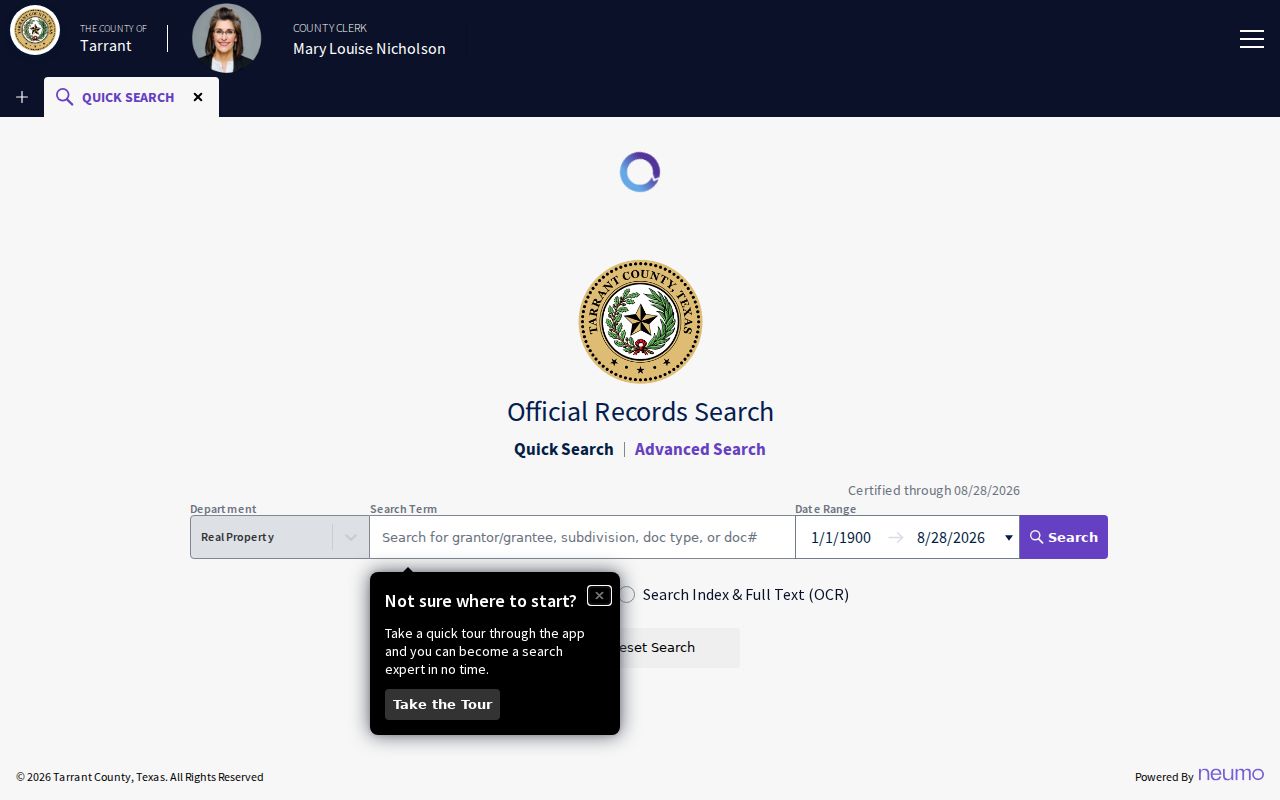
The search screen is a starting point for past residents research, while the archive and clerk channels handle the documented older record layers.
Mansfield Previous Residents and Old Names
Older Mansfield sources can use a different place or street name. Water Street later became Main Street, though the official history did not establish the year of the change. Britton was Helland and then Hellandville before its documented November 13, 1896 name. A historic deed may use a community name, lot and block, or railroad reference instead of a modern situs address.
Search Water and Main, plus Helland, Hellandville, and Britton when the date makes them relevant. Then test the result against a plat, legal description, parcel map, and county. An absent address entry does not prove that a property was empty.
Mansfield Past Residents in Regional Directories
The regional Greater Dallas White Pages at UNT are the documented address clues for 1981, 1983, 1984/85, and 1995. They are Southwestern Bell volumes, not Mansfield-only city directories or a verified local reverse run. An entry generally supplies a name, address, and telephone line, sometimes with a local exchange or business classification. Use it to test continuity near a transfer year, then verify it through a deed, census, obituary, probate file, or another dated record.
A gap between two white-page years is not proof of a move. The historical shelf and access caveats are kept with the Mansfield city directories collection, which is the right route for identifying the available local-history sources.
See the digitized 1983 Greater Dallas White Pages page before treating a regional listing as a Mansfield-specific directory.
The page image illustrates the type of dated regional evidence that can support, but not independently prove, a past Mansfield address connection.
Pair Mansfield Directories With Census
Use a directory or white-pages year as an address lead, then pair it with the released federal census schedule nearest in time. Census schedules are available under the 72-year rule and can identify a household's age, birthplace, relationship, occupation, and community. Their geography may be a county, precinct, or township rather than the later Mansfield city boundary, so the geographic label must be read in its historical setting.
- Place the dated parcel transfer on a simple timeline.
- Add a regional directory entry or museum newspaper clue close to that transfer.
- Check the available census schedule for the same surname, age pattern, and historical geography.
- Compare the address wording, nearby community name, and legal parcel evidence before drawing a conclusion.
Obituaries, cemetery references, and probate filings can explain a final transfer or connect a family name to an estate. The Mansfield Historical Museum has 1800s obituaries, newspaper articles, family notebooks, photographs, PastPerfect material, and microfilm, but it is not described as a complete population index.
Mansfield Previous Residents Museum Support
The Mansfield Historical Museum research library is the local fallback when a parcel trail needs a newspaper, obituary, photograph, or family-history lead. It is at 102 N Main Street and is open Tuesday through Saturday from 10 a.m. to 4 p.m. The museum recommends a targeted research-assistant request because staff support is limited. Give a surname, approximate decade, street or community, and the type of material sought.
Record the collection title, box, folder, reel, page, or PastPerfect identifier returned by the museum. That citation makes it possible to test a local story against the clerk index or an archive volume later.
No official Mansfield house-history guide was located. The practical local route is to ask the museum or Historical Society about the street, subdivision, former street name, and surname, then take any resulting date or name to the appraisal district and Official Public Records index. Sanborn map coverage for Mansfield was not located in the inspected Library of Congress search. Until an archive confirms an edition, use plats, city GIS, aerial layers, historic newspapers, and the documented parcel chain rather than assuming a fire-insurance map exists.
Mansfield Previous Residents Household Leads
Ownership and residence are different historical questions. A deed establishes a recorded transfer; a white-pages entry, census line, obituary, or newspaper notice can add a dated household lead. Use the legal description to hold the property steady while comparing sources. The Tarrant archive tax rolls identify a taxable owner, not every person associated with an address. The museum's files and regional directories may help explain a family connection, but their details should be corroborated.
When the public trail ends, ask the relevant custodian whether it holds an existing record and what copy route applies. A narrow Texas Public Information Act request can ask for a defined category and date range, but it does not make confidential records public or require a new investigation. Keep the purpose to family history, estate work, or personal house history, and respect protected information.
Lawful use. Mansfield past-resident research supports family, estate, and address history. Do not use a historical trail to stalk, harass, track, intimidate, or harm a living person.